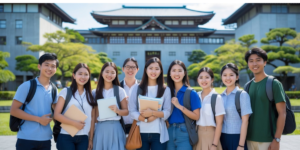
Some of the most prominent colleges in the world are located in Japan, as the Best Universities in Japan for International Students the Complete Guide shows, offering foreign students excellent education, reasonably priced tuition compared to Western nations, and promising employment prospects upon graduation. Japan has quietly emerged as one of the most alluring study-abroad destinations in the world. Studying in Japan offers foreign students an unparalleled blend of academic excellence and cultural immersion, thanks to its top-notch research institutes, much lower tuition than at Western colleges, and generous government grants. This guide includes all you need to know about the top colleges in Japan for international students, whether you’re drawn to Kyoto’s ancient campuses, Tokyo’s University of Tokyo, or globally focused private institutions like Waseda and Sophia.
Why Japan is Attractive for International Students
There has never been a better time to study in Japan. Over 280,000 foreign students studied in Japan in 2023, a startling 21% rise from 2022. This increase reflects the nation’s growing standing as an accessible, reasonably priced, and intellectually demanding travel destination.
Japan is being chosen by overseas students for the following reasons
Reasonably priced tuition, National institutions are far less expensive than those in the US, UK, or Australia, with annual tuition of only ¥535,800 (~$3,600 USD). Top universities in Japan do state-of-the-art research in science, engineering, and technology, and the country has produced 29 Nobel laureates. Safety and quality of life ,With first-rate public transportation, healthcare, and infrastructure, Japan routinely ranks among the world’s safest nations. Career opportunities, Due to a labor shortage, Japan aggressively seeks out foreign graduates, particularly in business, engineering, and technology. Rich culture, From traditional festivals to state-of-the-art technologies, living in Japan provides unmatched cultural richness.
Top National Universities in Japan
The best national universities in Japan are renowned worldwide for their outstanding academic programs, productive research, and robust support for international students. The University of Tokyo, regarded as one of the world’s greatest and renowned for its innovative research in science, engineering, and the humanities, tops the list. Kyoto University, known for producing Nobel Prize winners and fostering innovation, comes in second. Osaka University and Nagoya University are also well-known, offering a variety of English-taught programs and strong industry ties, especially in technology, automotive, and medical fields. Hokkaido University is a leader in agricultural and environmental studies, while Tohoku University in Sendai is renowned for its innovative research and inclusive policies. Kyushu University in Fukuoka is notable for its diverse programs and assistance to overseas students. Collectively, these establishments embody Japan’s dedication to providing top-notch education, providing international students with reasonably priced tuition, cultural immersion, and robust career opportunities in the most developed economy in Asia.
University of Tokyo (UTokyo)
Japan’s most esteemed national university, the University of Tokyo (UTokyo), consistently ranks among the best in the world. Since its founding in 1877, it has become a center of global cooperation, academic excellence, and innovation. To attract international students, UTokyo offers a broad range of undergraduate and graduate programs across engineering, medicine, law, economics, and the humanities. Many of these programs offer courses in English. Its campuses, including Hongo, Komaba, and Kashiwa, boast cutting-edge libraries and research facilities that foster a lively academic atmosphere. Tokyo is well known for generating Nobel Prize winners, leading the way in scientific and technological research, and forming Japan’s political and intellectual elite. The institution offers robust support services, such as housing aid, cultural integration programs, and scholarships, for overseas students. Compared with Western colleges, tuition costs are relatively low, and students benefit from Japan’s secure environment and robust economy.
Kyoto University
One of Japan’s most prominent national institutions, Kyoto University has led the world in innovation and research since its establishment in 1897. It is well known for its academic independence, multidisciplinary approach, and strong focus on autonomous study. It is in the ancient city of Kyoto. With several Nobel Prize winners and groundbreaking discoveries in disciplines including chemistry, physics, medicine, and environmental science, the university routinely ranks among the best in Asia and the world. To attract international students, Kyoto University offers various undergraduate and graduate programs, many of which are taught in English. The three main campuses host modern research facilities, libraries, and active student communities. Yoshida, Uji, and Katsura. Scholarships, housing assistance, and cultural integration initiatives help international students adjust to life in Japan more easily. Compared with Western colleges, tuition is reasonably priced, and Kyoto offers a distinctive fusion of modernity and heritage that enhances the educational experience.
Osaka University
Founded in 1931, Osaka University is one of Japan’s top national institutions and a center of worldwide cooperation, innovation, and research. It is well known for its prowess in medicine, engineering, natural sciences, and social sciences, and it is situated in Suita, near Osaka. With various programs taught in both Japanese and English, the university is very accessible to international students and routinely rates among the best in Asia. With close connections to business and government, Osaka University is especially well-known for its state-of-the-art research in biotechnology, robotics, and advanced medicine. Its three main campuses—Suita, Toyonaka, and Minoh—offer cutting-edge facilities, lively student communities, and libraries. Scholarships, housing assistance, and cultural integration initiatives help international students adjust smoothly to academic and social life in Japan.
Tohoku University
In 1907, Japan established one of its most prominent national institutions, Tohoku University, in Sendai. It is well-known for its innovative research and inclusive policies. Its longstanding dedication to diversity and openness shows that it was the first institution in Japan to admit female students and foreign academics. Tohoku University is now well-known worldwide for its prowess in materials science, engineering, medical research, and disaster resilience studies, especially after taking the lead in recovery research following the 2011 earthquake and tsunami. The university offers many of its various undergraduate and graduate programs in English, making it easy for international students to enroll. Its four main campuses—Kawauchi, Aobayama, Seiryo, and Katahira—boast state-of-the-art labs, libraries, and student amenities. Scholarships, housing assistance, and cultural integration initiatives help international students adjust smoothly to academic and social life in Japan.
Institute of Science Tokyo (formerly Tokyo Tech)
One of Japan’s most prominent national institutions focused on science, engineering, and technology is the Institute of Science, Tokyo, formerly known as the Tokyo Institute of Technology (Tokyo Tech). The institution, founded in 1881 and renamed in 2024 to better reflect its broader mission, has long been a leader in innovation, producing top-notch research and graduates who make substantial contributions to both academia and industry. Its three major campuses—Ookayama, Suzukakedai, and Tamachi—are located in Tokyo and equipped with cutting-edge labs, libraries, and collaboration areas. The university’s engineering, materials science, computer science, and biological sciences disciplines are especially well-known. Because so many courses are available in English, students from other countries find it quite accessible.
Top Private Universities in Japan for International Students
Private institutions in Japan provide a distinct experience. Best Universities in Japan for International Students the Complete Guide, they are frequently more globally focused, provide more English-language programs, and have lively campus cultures.
University of Waseda
Waseda is the most globally renowned private university in Japan and often ranks in the top 200 worldwide. Prime ministers, corporate executives, and prominent members of the Asian media are among its graduates.
More than fifty English-language courses in business, data science, cultural studies, and other subjects
With more than 9,000 foreign students, the community is lively.
Outstanding career placement, particularly in Japanese companies
Jochi Daigaku’s Sophia University
Sophia, a pioneer of English-medium education in Japan, was founded on Jesuit principles and is located a short distance from Shinjuku. Among the main benefits are
little seminars with just 20 students on average
courses in international relations, politics, languages, and sustainable development
High-achieving non-Japanese candidates are eligible for up to 100% tuition reimbursement.
Strong liberal arts heritage and first-rate language assistance
ICU stands for International Christian University
Students may choose to declare a double major and combine English and Japanese courses through ICU’s distinctive bilingual curriculum. Characteristics
About 20 pupils in each class
International students frequently qualify for four-year tuition subsidies worth 30–100%.
A strong focus on intercultural competency
Education in the liberal arts across disciplines
How to Apply to Japanese Universities as an International Student
Japan lacks a single application platform, unlike many other nations. Best Universities in Japan for International Students the Complete Guide. Every university has its unique admissions procedure. This is a broad road map:
Examine Your Options 18 to 24 months before your intended enrollment date and research colleges and programs. Find courses that fit your educational background and professional objectives.
Verify Language Needs
For programs taught in English, students usually need a TOEFL iBT score of 80–100+ or an IELTS score of 6.0–7.0.
Programs taught in Japanese often require JLPT N2 or N1.
The majority of undergraduate programs at national institutions require the EJU (Examination for Japanese University Admission for International Students).
Get Your Application Ready
Academic transcripts (in either English or Japanese)
Test results for language proficiency
Letters of recommendation (usually two to three)
Research proposal or personal statement (for graduate applications)
Regarding postgraduate students: Before applying, contact a potential faculty supervisor.
Submit an application and await admission tests. Several colleges require an additional admission exam. Applications for the April intake normally close in November or January, while those for the September/October intake close in March or June.
Get a Visa for Students. After being accepted, visit the closest Japanese embassy or consulate to apply for a College Student visa. Your university will assist you in obtaining your Certificate of Eligibility (CoE).
Final Words
Best Universities in Japan for International Students the Complete Guide Both public and private institutions in Japan offer foreign students a special combination of affordability, cultural immersion, and academic excellence. While private universities like Waseda, Keio, and Sophia offer various English-taught programs and robust international networks, prestigious institutions like the University of Tokyo, Kyoto University, and Osaka University lead the world in research and innovation. Japan guarantees that students can succeed intellectually and financially, with comparatively low tuition compared to Western nations, significant subsidies from MEXT and JASSO, and clear avenues for part-time employment. Beyond academics, the nation provides a secure environment, cutting-edge infrastructure, and a rich cultural legacy that make student life fulfilling and motivating. All things considered, Japan’s higher education system offers access to top-notch education and global employment opportunities, making it one of the most alluring destinations for international students seeking quality and cultural richness.